Microplastics, Plastic , In Your Food, In Your Air, In your Body
I Studied microplastics in a lab; Traveled globally and saw it brought to scale.
In 2020, I was a marine biology student at the University of Central Florida, standing over a Leica dissecting microscope counting plastic particles in a petri dish. The study was straightforward in concept: *Do microplastics end up in your lunch through the use of plastic food containers?
The answer was yes. Overwhelmingly, disturbingly yes.
What I didn’t know then was that five years later I’d be living in Indonesia — one of the most plastic-polluted nations on Earth — watching that same question play out not in a controlled lab setting, but in rivers, on beaches, and in the daily lives of communities with no say in the contamination happening around them.
This is the bridge between those two moments. And it’s the reason plastic has become one of the central causes of my life.
The Study: What We Found in Your Lunch
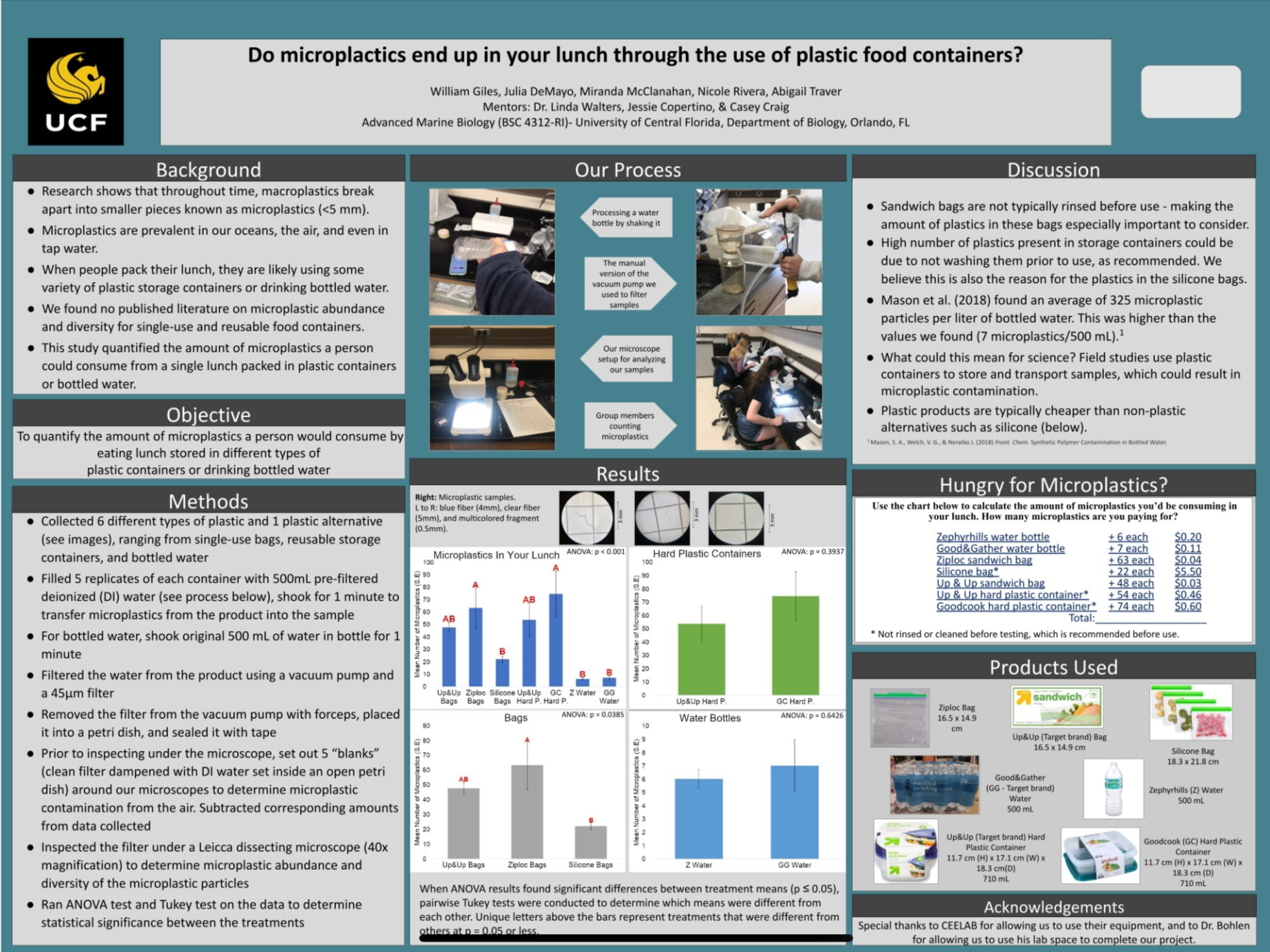
As part of UCF’s Advanced Marine Biology program under mentors Dr. Linda Walters, Jessie Copertino, and Casey Craig, our team — William Giles, Julia DeMayo, Miranda McClanahan, Abigail Traver, and myself — set out to quantify something nobody had formally studied: how many microplastics does a person consume from a single lunch stored in everyday plastic containers or bottled water?
We tested 6 types of plastic and one alternative, including Ziploc bags, Up&Up sandwich bags, silicone bags, Good&Gather bottled water, Zephyrhills water bottles, and Goodcook hard plastic containers. Each container was filled with 500mL of pre-filtered deionized water, shaken for one minute to simulate real use, then filtered through a 45µm vacuum pump filter. We inspected every filter under 40x magnification, categorizing microplastic particles by fiber type, size, and color.
The results were statistically significant.
- Sandwich bags - were among the highest contributors — and critically, most people never rinse them before use
- Hard plastic containers- showed measurable contamination, with Up&Up hard plastic averaging **+94 microplastics per container**
- Bottled water- yielded particles too, though at lower levels than our containers — still, 7 microplastics per 500mL
- Silicone bags- performed better, but were not entirely clean — and cost significantly more, making them inaccessible to most households
- A single packed lunch could expose you to an estimated **$0.60 worth of microplastics** — a darkly useful way to frame the invisible cost of cheap packaging
ANOVA results confirmed significant differences between treatment groups (p ≤ 0.05). The science was clear. The contamination was real. And it was coming from products sitting in virtually every home in America
At a Glance
- Conducted at UCF’s Department of Biology under Dr. Linda Walters
- Tested 7 container types including bags, hard plastics, silicone, and bottled water
- Used ANOVA and Tukey statistical tests — results significant at p < 0.001 for bags
- Microscopy performed at 40x magnification using a Leica dissecting microscope
- Sandwich bags — rarely rinsed before use — among the highest microplastic sources
- Average of 7 microplastics per 500mL of bottled water detected
- Silicone was the safest alternative tested, but cost remains a barrier to access
- Little published literature existed at the time on microplastic abundance in single-use food containers — this was new ground
The Reality: There Are No Control Groups Left
Here is what the science community is quietly grappling with, and what I think the public deserves to hear plainly.
To study the effects of microplastics on the human body, you would need a control group — people with no microplastic exposure to compare against those who have been exposed. That group no longer exists.
Microplastics have been found in human blood, lung tissue, placental tissue, breast milk, and most recently, in arterial plaque. They have been detected in the most remote corners of the planet — in Arctic ice, in Mariana Trench sediment, on the summit of Mount Everest. There is no uncontaminated baseline human population left to study.
What this means is that we are running a global experiment on ourselves, in real time, without consent, and without a way to measure the full scale of damage because we have nothing to compare it to. We cannot go back. We can only slow what is still coming.
That is not a reason for despair. It is a reason for urgency.
Indonesia: Where the Lab Becomes Real Life
When I traveled to Indonesia post grad in 2022 and once again in early 2026 to complete my Divemaster internship, I knew the country had a plastic problem. During this time I have felt only a small glance at what it feels like to be inside
Indonesia is the second largest contributor of plastic pollution to the ocean in the world. Rivers carry waste from inland communities to coastlines. Beaches that should be pristine are lined with single-use packaging. Fishing communities whose health and livelihoods depend on the ocean are surrounded by the very plastic that is poisoning it. And many of those communities didn’t create this problem — the infrastructure, the corporate packaging decisions, the global trade of cheap plastic goods — those forces arrived from the outside.
What I found in my UCF lab in 2020 was a measurable, localized snapshot of a global crisis. What I see in Indonesia is the downstream consequence of a world that never took that snapshot seriously enough.
Work That Matters
Driving, Supporting and doing work that truly matter. There’s many organizations out there spear heading this problem and raising awareness on a large scale. However this problem goes beyond one person, one action, one organization, it will take a village. One organization doing great scalable work on this problem is Sungai Watch, an Indonesia-based nonprofit using river barrier systems to intercept plastic waste before it reaches the ocean. Their approach is infrastructure-meets-community: installing floating barriers in rivers, collecting and sorting the waste, and building local employment and education around the process.
What I love about this model is that it doesn’t wait for governments or corporations to fix it. It works with what exists; rivers, communities, people who care; and builds something functional now. It is conservation work in the truest sense: not studying the problem from a distance, but physically standing between the waste and the ocean.
The war on plastic is a complex, multi layered issue. From infrastructure, to laws, to education, to culture, to basic survival needs. This problem, as a whole is a bigger scale than any realize. It’s the kind of work I want to be part of. My research background, my understanding of plastic contamination at a microscopic level, my time in the field, and my history of community education private me to be part of the movement driving the change.
What You Can Do
The study we ran at UCF had a small, practical conclusion hidden inside the data: rinse your containers before use. Sandwich bags showed some of the highest contamination, and most people never wash them. That single habit change reduced exposure in our testing.
But individual action only goes so far. The bigger levers are:
- Supporting organizations like Sungai Watch; who are intercepting plastic at scale
- Pushing for extended producer responsibility; making the companies that manufacture single-use plastic accountable for its end of life
- Participating in beach and river cleanups; as both a removal effort and a data collection opportunity
- Talking about this; the science is real, the health implications are real, and public awareness is still one of the most powerful tools we have
The Bridge
I started with a petri dish and a microscope in Orlando. I ended up on a beach in Indonesia watching plastic wash ashore with the tide.
Those two things are not separate stories. They are the same story, told at different scales. The microplastic in your sandwich bag and the plastic in an Indonesian river both come from the same source: a global culture that decided convenience was worth more than consequence.
I don’t believe that anymore. And I’m building a career around saying so.
